
Moody's Ratings has reduced India's GDP growth forecast for 2026 to 6 per cent, citing subdued private consumption, capital formation, and industrial activity due to higher energy costs and global uncertainties.

External Affairs Minister S Jaishankar addresses the Indian Ocean Conference, expressing deep concern over the West Asia conflict and its economic repercussions on energy, trade, and food security. India calls for a swift return to peace and opposes targeting civilians and infrastructure.

Indian companies, however, are now paying a premium of $6-$7 a barrel for Russian oil, compared with discounts of $8-$10 a barrel before the start of the conflict.

The rupee weakened to a record low against the US dollar due to Gulf tensions, rising oil prices, and foreign capital outflows.

Despite President Trump's optimistic prediction of a swift resolution to the ongoing conflict with Iran, Tehran dismisses any possibility of diplomatic breakthroughs, citing deep distrust and highlighting the complexities of US-Iran relations.

Iranian foreign ministry spokesperson Esmaeil Baghaei said that the country has held no "direct" talks with the United States as of now and added that it has received messages through some mediators regarding the US' desire for negotiations.
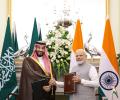
Prime Minister Narendra Modi spoke with Saudi Arabia's Crown Prince Mohammed bin Salman about the ongoing conflict in West Asia, emphasising the need to ensure freedom of navigation and secure shipping lanes.
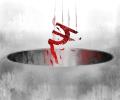
The Indian rupee is highly vulnerable among Asian currencies, with Barclays and MUFG warning of a potential depreciation towards 100/$ if the West Asia conflict persists, driven by widening current account deficits and elevated crude oil prices.

'Despite the large number of missiles and drones we have already launched, we still possess reserves and missile cities whose doors have not yet been opened,' says Iran's Consul-General Saeid Reza Mosayeb Motlagh.

RBI Governor Sanjay Malhotra stated that the central bank is closely monitoring whether the supply shock from the West Asia conflict will lead to a generalised price rise, potentially necessitating monetary policy action.

Indian benchmark indices, Sensex and Nifty, opened lower on Tuesday, driven by a surge in global crude oil prices and continued outflows by Foreign Institutional Investors (FIIs), reflecting fragile market sentiment influenced by external factors.

India has summoned the US charge d'affaires for the second time this week to protest American Navy strikes on three commercial vessels off the coast of Oman, which resulted in the deaths of three Indian crew members. New Delhi has demanded an end to these attacks, acknowledging that the US Navy targeted the ships, some of which were reportedly non-compliant with US sanctions.

Yousef Pezeshkian, the son of the Iranian President, has confirmed that Iran's Supreme Leader Mojtaba Khamenei is 'safe and sound'. This comes after certain reports claimed that he had been injured during the ongoing strikes by the United States and Israel, according to Al Jazeera.

Former US President Donald Trump claimed he stopped a war between India and Pakistan and expressed his desire to be remembered as a great peacemaker.

Gold prices in the national capital surged by Rs 600 to Rs 1.65 lakh per 10 grams, extending gains for the third consecutive day, while silver rebounded by Rs 5,000 to Rs 2.71 lakh per kilogram, driven by geopolitical tensions and inflation concerns.

The Indian rupee depreciated by 32 paise to close at 92.83 against the US dollar, influenced by escalating global tensions, particularly the US-Iran conflict, and the deadline for the RBI's instructions to banks to curb overnight positions.

The Indian government has increased import duties on gold and silver from 6 per cent to 15 per cent to curb inbound shipments of precious metals amid a rising import bill due to the West Asia crisis.

Navy Chief Admiral Dinesh K Tripathi revealed that the Indian Navy was on the verge of striking Pakistan during Operation Sindoor following the Pahalgam terror attack, but kinetic actions were stopped. He also discussed the impact of the West Asia conflict on maritime traffic.

Indian markets on Dalal Street rallied sharply as easing tensions in the US-Iran conflict and stable oil prices boosted sentiment. Track Nifty 50 and BSE Sensex performance and key global triggers.
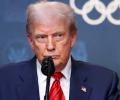
Each time a deadline almost runs out, President Trump hands out a new one.

External Affairs Minister S Jaishankar discussed the West Asia conflict and its impact on energy supplies with his Russian counterpart Sergey Lavrov and EU's Foreign Policy chief Kaja Kallas.

India has strongly protested a US military strike on the commercial vessel Settebello off the Oman coast, which left three of the 24 Indian crew members missing. The US Central Command stated it disabled the Palau-flagged vessel for violating a blockade of Iranian ports.

India emerged reasonably well from 2025. But now, the oil shock and war-related supply disruptions have again driven funds out of India and significantly weakened the rupee, points out Ajay Chhibber.

Direct talks between the US and Iran, mediated by Pakistan, have failed to produce an agreement after 21 hours of negotiations, with disagreements over Iran's nuclear ambitions and sanctions proving insurmountable.

Facing escalating threats from the US, Iran is mobilizing its citizens to form 'human chains' around power plants as a defensive measure against potential airstrikes, raising concerns about international law and civilian safety.

Government sources indicate a potential increase in petrol and diesel prices due to rising global crude oil costs and losses incurred from a prolonged freeze on retail rates.

The US and Iranian delegations left Pakistan after failing to reach an agreement in historic talks aimed at resolving the West Asia conflict and stabilising global energy markets.

Congress leader Rahul Gandhi has warned of a severe economic crisis looming over India, criticising Prime Minister Narendra Modi's economic policies and foreign travels.

The US has seized an oil tanker, 'Skywave', linked to Iran in the Indian Ocean, as part of efforts to disrupt Iran's oil shipments and enforce sanctions. The vessel was part of a network transporting sanctioned Iranian crude oil, with the seizure occurring amid heightened tensions between Washington and Tehran.

The closure of the Strait of Hormuz has disrupted some 20 per cent of the global flows but even if it opens, damages to production facilities in the region will take time to repair, points out Sunita Narain.

Donald Trump's inconsistent statements and actions regarding the conflict with Iran have drawn criticism and confusion, raising questions about American credibility and the direction of US foreign policy.

Iran has presented a multi-layered proposal to the US in an attempt to break the deadlock in peace talks, focusing on de-escalation and nuclear programme discussions.

The United States and Iran have reached an agreement in principle to immediately and permanently halt all military operations, lift sanctions, and work towards a comprehensive final agreement within 60 days, including a significant reconstruction package for Iran.

This sharp Iranian response came after a series of uncompromising remarks from the US president.

'The real shock is going to be from a deficient monsoon.'

Amidst the ongoing conflict in West Asia, the Oil Ministry assures citizens that India's LPG supply remains secure, with no need for panic booking of cylinders. The normal delivery cycle of two-and-a-half days is being maintained, and crude oil is being sourced from diverse routes.

India is well-stocked with inventories of crude oil and key petroleum products, including petrol, diesel, and aviation turbine fuel (ATF), to deal with short-term disruptions as the war intensifies in West Asia, Union Minister of Petroleum and Natural Gas Hardeep Singh Puri said on Tuesday.

The United States Central Command (CENTCOM) has confirmed the implementation of a naval blockade on Iranian ports, enforcing strict measures on vessels entering or departing, significantly escalating tensions between the two nations.

The remarkable rise of smallcaps reflects the emergence of a broad set of specialised businesses operating in industries where the sectoral tailwinds remain considerably stronger than macroeconomic headwinds, points out Debashis Basu.

Indian benchmark stock indices, Sensex and Nifty, recorded their fourth consecutive day of declines, driven by selling in FMCG, financial, and auto sectors. The downturn is attributed to fresh tensions in the Middle East, uncertainty surrounding the US-Iran 60-day ceasefire, and elevated crude oil prices.
